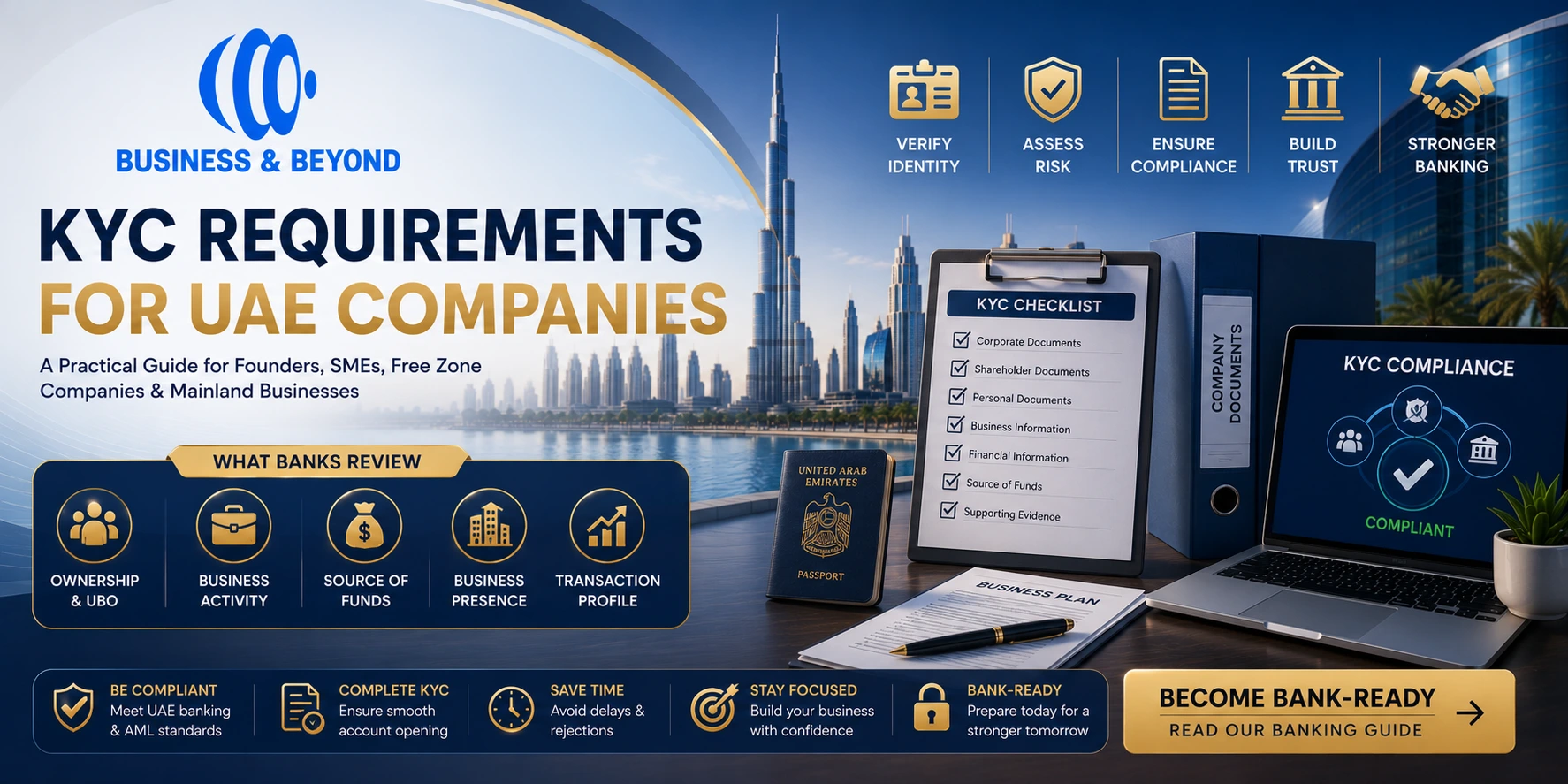
KYC Requirements for UAE Companies
A practical guide for founders, SMEs, free zone companies and mainland businesses preparing for UAE corporate bank account KYC, AML review and banking compliance.
What Banks Review
- Company ownership and UBO structure
- Business activity and operating model
- Source of funds and source of wealth
- Office presence and business substance
- Expected transactions and customer profile
Many business owners believe opening a corporate bank account is simply a matter of submitting a trade license and passport copy. In reality, UAE banks follow a risk-based KYC framework that goes far beyond basic documentation.
Whether you recently completed your business setup in Dubai, established a free zone company, or incorporated a mainland entity, your ability to open and maintain a corporate bank account depends heavily on how well you satisfy the bank’s compliance requirements.
Banks are not only checking who you are. They are assessing how your business operates, where your money comes from, who ultimately owns the company, and whether your expected transactions make commercial sense.
What Is KYC in UAE Banking?
KYC, or Know Your Customer, is the process banks use to verify the identity, ownership, business activities and financial legitimacy of customers.
For UAE companies, KYC forms part of wider anti-money laundering and counter-terrorism financing expectations. The Central Bank of the UAE supervises AML/CFT standards across licensed financial institutions, which is why banks must understand a company before approving a banking relationship.
For corporate customers, this usually includes reviewing shareholders, ultimate beneficial owners, business activities, expected account activity, transaction countries and the source of funds.
Why UAE Banks Have Strict KYC Requirements
UAE banks operate under strict AML/CFT expectations. This means they must conduct customer due diligence, assess risk and monitor customer relationships on an ongoing basis.
The UAE’s official AML framework is supported by regulatory bodies including the Central Bank, the UAE Financial Intelligence Unit and the Ministry of Economy’s AML guidance for relevant businesses.
From a founder’s perspective, this is why banks ask questions that may feel detailed: who your customers are, which countries you trade with, how revenue is generated, and why the expected account activity matches your business model.
KYC Documents Required for UAE Companies
| Document | Why Bank Requests It | Common Issues |
|---|---|---|
| Trade License | Confirms the legal existence and licensed activity of the company. | Expired license or activity not matching the business model. |
| MOA / AOA | Verifies shareholders, ownership rights and company structure. | Missing amendments or inconsistent shareholder details. |
| Shareholder Documents | Identifies company owners and controlling parties. | Expired passports or incomplete ownership records. |
| Passport Copies | Used for identity verification of shareholders and signatories. | Unclear scans or expired documents. |
| Emirates ID | Confirms UAE residency identity where applicable. | Not updated after renewal. |
| Visa Copy | Confirms immigration and residency status. | Expired visa or mismatch with application details. |
| Office Lease / Ejari | Shows business presence and operational substance. | Virtual office concerns or insufficient address evidence. |
| Website | Helps banks understand business legitimacy and services. | Incomplete website or no clear service explanation. |
| Business Plan | Explains activity, revenue model, customers and expected transactions. | Generic or unrealistic projections. |
| Invoices / Contracts | Proves real commercial activity. | No signed agreements or weak supporting evidence. |
| Proof of Business Activity | Supports transaction expectations and operational substance. | Activity does not match trade license. |
| Source of Funds Evidence | Supports AML review and funding legitimacy. | Unexplained capital transfers. |
Ultimate KYC Checklist for UAE Companies
Corporate Documents
- Trade license
- MOA / AOA
- Share register
- UBO declaration
Personal Documents
- Passport copies
- Emirates ID
- Visa copy
- Proof of address if requested
Business Evidence
- Company profile
- Website
- Office lease / Ejari
- Business plan
Commercial & Financial Proof
- Customer contracts
- Supplier agreements
- Invoices
- Source of funds records
This checklist should be reviewed alongside your wider bank account requirements in the UAE, because different banks may request additional supporting documents based on activity, shareholder profile and risk classification.
Understanding Ultimate Beneficial Owner Requirements
One of the most important parts of UAE corporate banking compliance is UBO verification.
A UBO is the natural person who ultimately owns or controls the company. Banks must identify not only direct shareholders, but also individuals behind corporate shareholders or layered ownership structures.
The UAE has strengthened beneficial ownership transparency as part of its AML framework. The UAE Ministry of Economy has also highlighted the importance of developing the Ultimate Beneficial Owner framework in coordination with licensing authorities and company registrars.
For example, if a holding company owns the UAE company, the bank will usually look through the holding company to identify the actual individual behind the structure.
Source of Funds and Source of Wealth Requirements
Many applications are delayed because founders underestimate source of funds requirements.
Banks may ask where the startup capital came from, how shareholder contributions were funded, and whether the money can be supported with bank statements, investment agreements, salary history, asset sale documents or business income records.
Common Supporting Evidence
- Shareholder bank statements
- Investment agreements
- Capital transfer records
- Employment income records
- Business revenue documents
- Asset sale agreements
Source of funds review is closely linked to AML compliance. The UAE Ministry of Economy’s AML information portal provides official guidance and legislative references for anti-money laundering obligations in the UAE.
KYC Requirements for Free Zone Companies
Free zone companies often face additional questions around operational substance, office presence, customer location and transaction profile.
This does not mean free zone companies cannot open accounts. It means documentation must be stronger and the business model must be clearly explained.
Founders should also review Free Zone Business Activity Rules before licensing, because activity selection can affect banking discussions later.
KYC Requirements for Mainland Companies
Mainland companies usually provide stronger evidence of local presence through office requirements, Ejari and operational licensing. However, banks still perform full KYC review.
Mainland status alone does not guarantee approval. Ownership clarity, business activity, source of funds and transaction logic remain critical.
Free Zone Companies
May need stronger evidence of operational substance, website, contracts and transaction purpose.
Mainland Companies
Usually provide clearer local presence, but still need complete KYC, AML and ownership documentation.
How Business Activity Affects KYC Review
Banks assess companies differently depending on activity.
- Consultancy: Banks review client type, service delivery and expected fees.
- Trading: Banks examine supplier network, product category, import/export routes and transaction volume.
- E-commerce: Banks look at payment gateways, fulfillment, website and customer geography.
- Logistics: Banks assess freight routes, jurisdictions and customer relationships.
- Higher-risk sectors: Additional due diligence may apply.
Why Banks Ask for Business Plans, Contracts and Invoices
Banks request these documents to understand whether the company is commercially real.
A business plan explains how the company earns revenue. Contracts show customer or supplier relationships. Invoices support actual or expected transaction activity.
These documents are especially important during corporate bank account opening in the UAE processes.
Most Common KYC Mistakes Companies Make
- Submitting incomplete documentation
- Providing inconsistent ownership information
- Using vague business descriptions
- Failing to explain source of funds
- Selecting business activities that do not match operations
- Providing unrealistic transaction expectations
- Approaching banks before becoming bank-ready
Why Banks Reject Applications Despite Complete Documents
Complete documents do not guarantee approval.
Banks may still reject applications due to risk profile concerns, unclear ownership, activity mismatch, weak commercial substance, insufficient source of funds evidence, or transaction expectations that do not align with company size.
For more detail, read our guide on Why Banks Reject Business Accounts UAE.
How to Become Bank-Ready Before Applying
Before approaching banks, founders should prepare before approaching banks and ensure their company documentation, business model, website, contracts, source of funds records and transaction profile are clear.
You can also compare options through our guide on the Best Banks for Business in UAE and review detailed Bank Account Requirements UAE.
Need to Become Bank-Ready?
Business & Beyond helps UAE companies review documentation, prepare banking files, understand compliance gaps and avoid avoidable compliance delays before approaching banks.
Speak to a Banking Readiness AdvisorHow Business & Beyond Helps Businesses Meet KYC Requirements
Business & Beyond supports founders with banking readiness assessments, document review, ownership structure review, source of funds preparation, business activity alignment and corporate bank account opening guidance.
As a premium business setup consultant in Dubai, our role is not only to help with licensing, but also to help businesses prepare for the compliance expectations that come after incorporation.
FAQ – KYC Requirements for UAE Companies
What is KYC?
KYC, or Know Your Customer, is the process banks use to verify identity, ownership, business activity and financial legitimacy before onboarding a customer.
Why do banks request so many documents?
Banks request documents to comply with AML obligations, verify ownership, understand the business model and assess customer risk.
What is a UBO?
A UBO, or Ultimate Beneficial Owner, is the natural person who ultimately owns or controls the company.
Do free zone companies face more scrutiny?
Free zone companies may be asked for stronger evidence of operational substance, office presence, contracts, website and source of funds.
Can incomplete KYC delay account opening?
Yes. Missing documents, inconsistent ownership details, weak business explanations or unclear source of funds can delay corporate bank account opening.