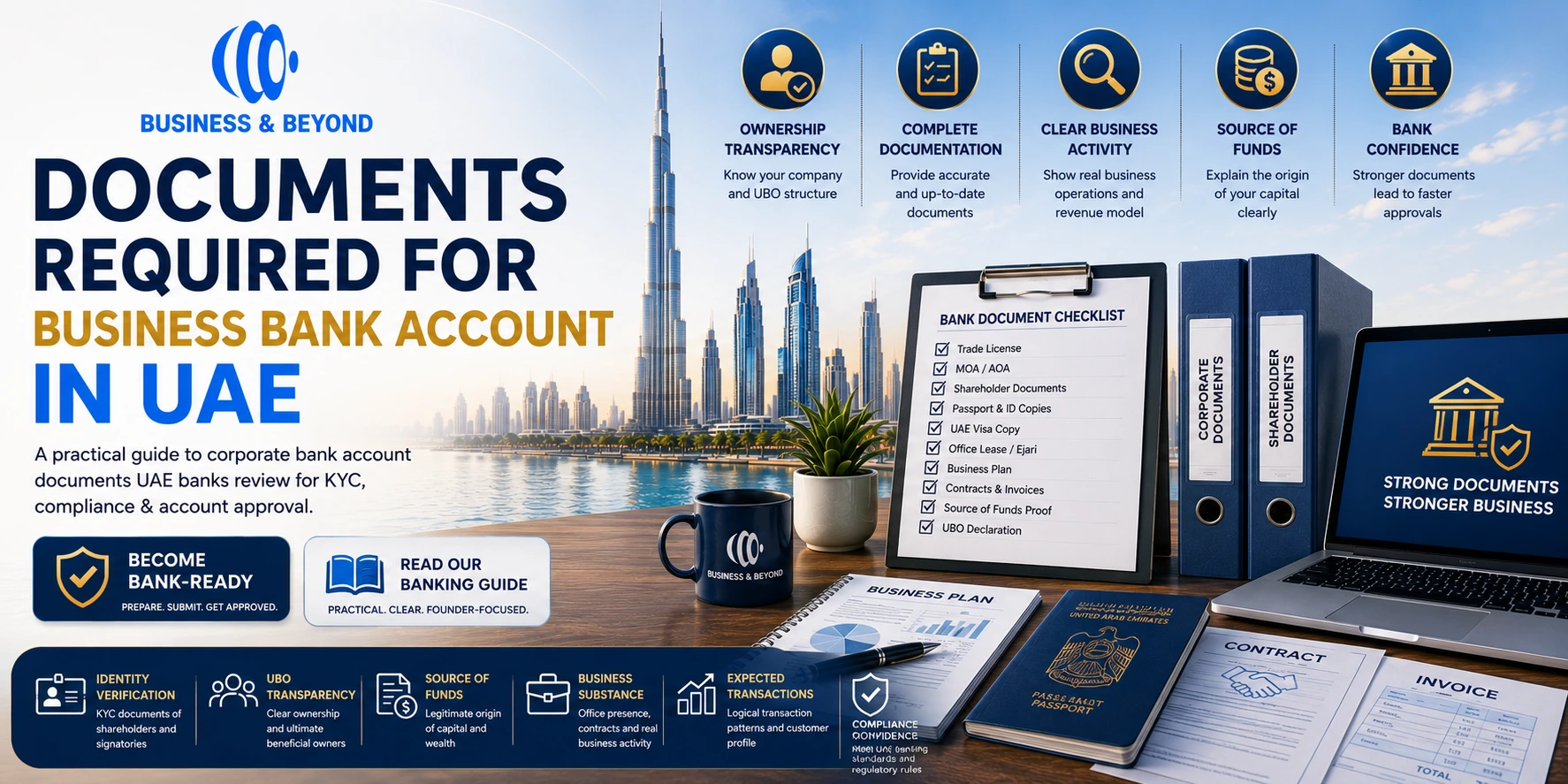
Documents Required for Business Bank Account in UAE
A practical, founder-focused guide to corporate bank account documents UAE banks usually review — including KYC, UBO, source of funds, activity proof, and free zone vs mainland documentation.
Banking File Must Prove
- Company ownership and UBO structure
- Source of funds and source of wealth
- Business activity and operating model
- Office presence and UAE substance
- Expected customers, suppliers and transactions
Many founders assume opening a business bank account only requires a trade license and passport copy. In reality, UAE banks assess the full company profile before approving a corporate account.
Whether you recently completed your business setup in Dubai, incorporated a free zone company, or formed a mainland entity, your banking documents must help the bank understand who owns the company, how the business earns money, where funds originate, and whether expected transactions make commercial sense.
This guide explains the key Documents Required for Business Bank Account approval in the UAE and how to prepare a stronger banking file before applying.
Why UAE Banks Request So Many Documents
UAE banks are required to follow Know Your Customer, Customer Due Diligence and AML procedures. The Central Bank of the UAE provides guidance to licensed financial institutions on customer due diligence, KYC and record keeping, which is why banks request detailed information during onboarding.
In practical terms, the bank is asking:
- Who owns and controls the company?
- What activity is the company licensed to perform?
- Where does the company’s capital come from?
- Who are the expected customers and suppliers?
- Do the projected transactions match the business model?
This is also why reading a proper KYC requirements UAE guide before applying is useful for founders, SMEs and foreign investors.
Corporate Bank Account Document Checklist
| Document | Purpose | Common Issues |
|---|---|---|
| Trade License | Confirms legal existence and licensed activity. | Expired license or activity mismatch. |
| MOA / AOA | Shows company constitution and shareholder rights. | Missing amendments or outdated documents. |
| Shareholder Register | Confirms ownership structure. | Ownership not matching license records. |
| Passport Copies | Identity verification for shareholders and signatories. | Expired passport or unclear copy. |
| Emirates ID | Verifies UAE resident identity. | Missing front and back copy. |
| UAE Visa Copy | Confirms residency and local presence. | Visa not linked to shareholder or manager. |
| Office Lease / Ejari | Proves operational substance. | Virtual office concerns or no valid Ejari. |
| UBO Declaration | Identifies ultimate beneficial owners. | Incomplete ownership disclosure. |
| Business Plan | Explains business model and transaction logic. | Generic plan with unrealistic projections. |
| Website | Supports business legitimacy and market presence. | No website or unclear services. |
| Contracts and Invoices | Proves real business activity. | Unsigned agreements or inconsistent invoice details. |
| Bank Statements | Shows financial history and funds movement. | Insufficient transaction trail. |
| Proof of Source of Funds | Supports AML and compliance review. | No clear evidence of capital origin. |
Documents Required from Shareholders
Shareholders are reviewed because banks must understand who owns, controls and financially supports the company. Common shareholder documents include passport copy, Emirates ID, UAE visa copy, residential address proof, personal bank statements, CV or professional profile, and source of wealth evidence.
For foreign shareholders, banks may also request overseas company records, business ownership documents, tax residency details, or proof of previous business income.
Documents Required from the Company
Company documents help the bank assess licensing, ownership and activity. These normally include trade license, incorporation certificate, MOA/AOA, shareholder register, UBO register, board resolution, office lease, activity approvals, contracts, invoices and financial records.
For regulated or higher-risk activities, banks may ask for additional approvals from the relevant authority before proceeding with account opening.
Source of Funds Documentation Explained
Source of funds is one of the most important parts of corporate banking requirements UAE. Banks need to understand where the money entering the company originates.
Startup Capital
Examples include personal savings, salary income, investment liquidation or family funding. Supporting documents may include personal bank statements and salary certificates.
Shareholder Investment
Where shareholders inject funds, banks may request transfer records, investment declarations, shareholder resolutions and proof of the shareholder’s financial capacity.
Business Income
Existing businesses may provide invoices, contracts, audited financials, VAT records, customer receipts and previous corporate bank statements.
UBO Documents Banks Usually Request
UBO means Ultimate Beneficial Owner. Banks must identify the individual persons who ultimately own or control the company. This is especially important where a UAE company is owned by another company, holding structure, nominee arrangement or foreign corporate shareholder.
Banks may request UBO declarations, ownership charts, parent company documents, shareholder registers, board resolutions and proof of control. UAE authorities have also continued strengthening the UBO framework, making transparency an important part of corporate compliance.
Additional Documents for Trading Companies
Trading companies usually need stronger activity proof because transaction values, supplier payments and cross-border movement of goods can be significant.
- Supplier contracts
- Customer purchase orders
- Commercial invoices
- Import/export records
- Shipping documents and bills of lading
- Warehouse or logistics agreements
- Product catalogue or website
Additional Documents for Consultants and Service Businesses
Consultants, agencies and professional service firms must prove that revenue is linked to genuine services. Banks may request service agreements, client contracts, engagement letters, proposals, portfolio evidence, professional licenses, marketing material and website pages explaining the services.
Additional Documents for E-Commerce Businesses
E-commerce companies often need to prove how sales are generated, collected and fulfilled. Typical documents include website URL, marketplace seller account, payment gateway agreement, supplier invoices, delivery arrangements, inventory records and online sales reports.
Free Zone vs Mainland Documentation Requirements
| Requirement | Free Zone Company | Mainland Company |
|---|---|---|
| Licensing Documents | Free zone license and incorporation documents. | DET trade license and MOA where applicable. |
| Office Evidence | Lease, flexi-desk or facility agreement. | Ejari is commonly expected. |
| Activity Proof | Contracts, website, invoices and operating evidence. | Contracts, invoices, approvals and commercial records. |
| Compliance Scrutiny | Depends on activity, shareholders and substance. | Depends on activity, shareholders and transaction profile. |
| Banking Expectations | Clear business model and substance preferred. | Clear operations, Ejari and transaction logic preferred. |
Free zone companies can open bank accounts in the UAE, but banks will still review substance, KYC, activity proof and transaction profile. For more detail, read our guide on bank account requirements UAE.
Most Common Document Mistakes That Delay Approval
- Expired passports, visas or trade licenses
- Business plan not matching the licensed activity
- Website describing services not listed on the license
- Weak source of funds evidence
- No contracts, invoices or customer proof
- Unrealistic projected turnover
- Unclear UBO or holding company structure
Why Banks Reject Applications Despite Complete Documents
A complete checklist is not the same as a bank-ready application. Banks may reject an account if the risk profile is unclear, the business model appears inconsistent, the source of funds is weak, the company has no operational substance, or projected transactions do not match the company’s size.
This is why founders should review why banks reject business accounts in UAE before submitting documents.
How to Become Bank-Ready Before Applying
Before applying, prepare documentation before applying, organize shareholder files, create a realistic business plan, collect activity evidence, prepare source of funds proof, update your website, and ensure every document tells the same story.
You can also compare banking options in our guide to the best banks for business in UAE.
Need Help Preparing Your Banking File?
Business & Beyond helps UAE companies become bank-ready through KYC review, documentation preparation, UBO structure assessment and corporate bank account opening UAE support.
Prepare Documentation Before ApplyingOfficial External References
For authority and reader trust, this article may naturally reference official UAE compliance resources:
FAQ – Documents Required for Business Bank Account
Do all UAE banks request the same documents?
No. Core documents are similar, but each bank applies its own risk-based onboarding process depending on activity, nationality, ownership structure, source of funds and expected transactions.
Is a business plan mandatory for a UAE business bank account?
Not always, but it is commonly requested for startups, new free zone companies, foreign-owned companies and businesses without transaction history.
Can free zone companies open business bank accounts in UAE?
Yes. Free zone companies can open corporate bank accounts, provided they satisfy KYC requirements, source of funds checks, business substance expectations and document review.
Why do banks request contracts and invoices?
Banks use contracts and invoices to verify that the company has genuine commercial activity and that expected transactions match the licensed business model.
What is source of funds evidence?
Source of funds evidence explains where the company’s money comes from, such as shareholder savings, business income, salary income, investment proceeds or previous company revenue.