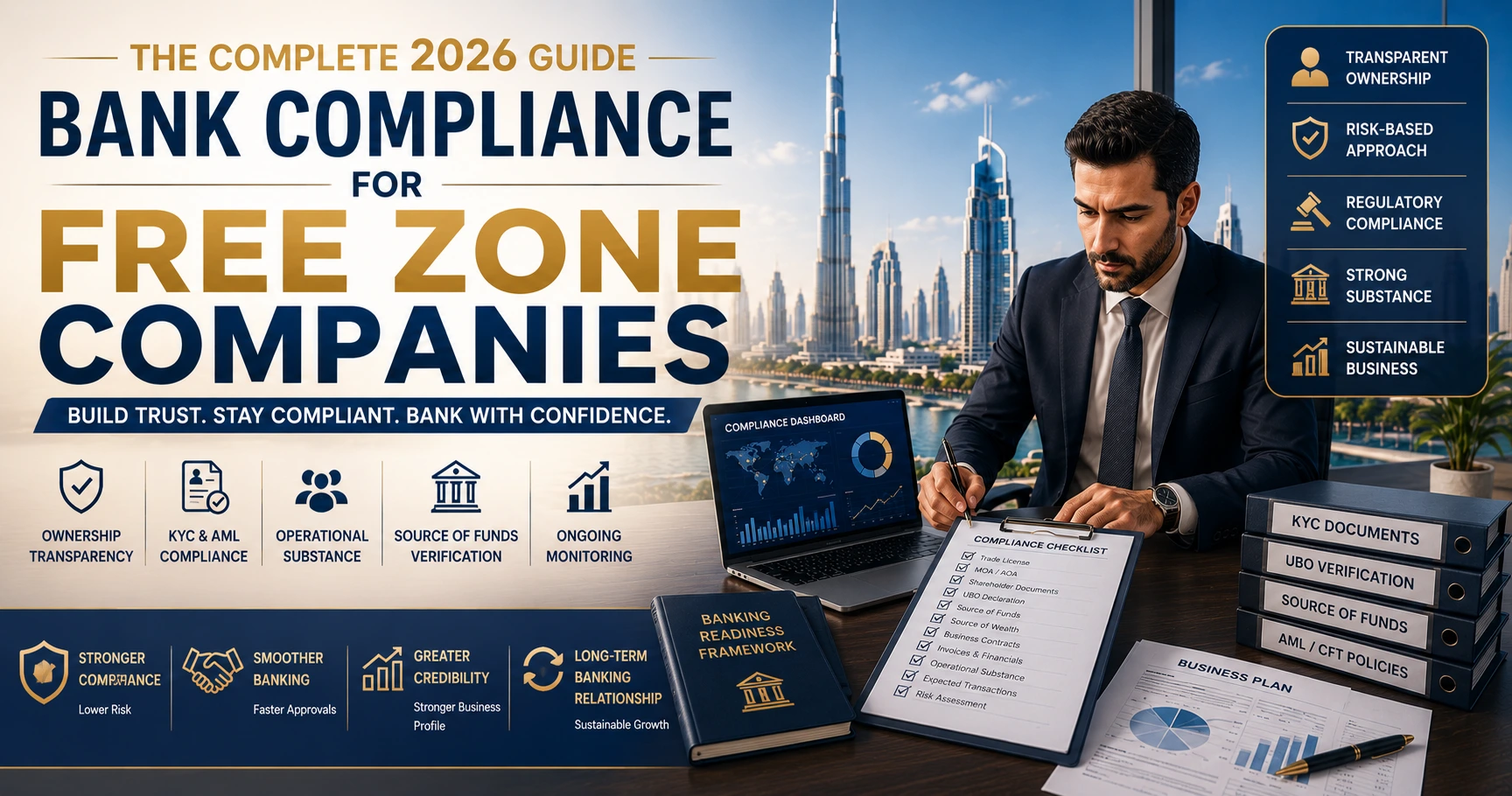
Bank Compliance for Free Zone Companies
A practical UAE guide explaining how banks assess free zone companies for KYC, AML, UBO, operational substance, source of funds, source of wealth and corporate banking readiness.
Many entrepreneurs believe that obtaining a free zone license automatically makes corporate banking straightforward. In reality, UAE banks evaluate risk, transparency, operational substance and compliance readiness — not merely the existence of a trade license.
This is especially important for investors completing business setup in Dubai. A license allows the company to exist. Banking compliance determines whether a bank is comfortable opening and maintaining a corporate account.
Why Bank Compliance Matters for Free Zone Companies
UAE banks operate under a risk-based compliance framework. They must understand the customer, the business model, the beneficial owners, the source of funds and the expected transaction behaviour. This is linked to AML and CFT obligations supervised by UAE authorities including the UAE Central Bank and the UAE AML framework.
A bank will ask practical questions:
- Who ultimately owns and controls the company?
- Where did the initial capital come from?
- Does the business activity match the license?
- Does the company have real operational substance?
- Are expected transactions reasonable for the business model?
A trade license alone does not open bank accounts.
Compliance readiness, documentation strength and operational substance make the banking profile stronger.
Why Banks Scrutinize Free Zone Companies
Free zone companies are attractive because they offer flexibility, foreign ownership and efficient incorporation. However, banks may apply additional review where the company has remote shareholders, cross-border transactions, limited physical presence or complex ownership structures.
Example 1: Consultant Company
A consultant receiving payments from clients in multiple countries must explain service scope, client contracts, invoices and expected monthly transaction volume.
Example 2: Trading Company
A trading business importing goods and selling internationally may be asked for supplier details, invoices, shipping documents, customer markets and payment routes.
Example 3: Holding Structure
A holding company may need to provide ownership charts, investment evidence, source of wealth records and information on subsidiaries or assets held.
Core Compliance Requirements for Free Zone Companies
| Compliance Area | What Banks Review | Common Issues |
|---|---|---|
| Trade License | Licensed activity, issuing authority, validity | Activity does not match actual business |
| Shareholders | Identity, nationality, ownership percentage | Incomplete shareholder documents |
| UBO | Ultimate beneficial owners and control structure | Undisclosed indirect ownership |
| Office Presence | Lease, flexi desk, serviced office, warehouse | Weak substance or virtual-only appearance |
| Business Activity | Commercial purpose and risk level | Vague business model explanation |
| Source of Funds | Origin of capital entering the company | Unsupported transfers |
| Source of Wealth | How shareholders built wealth over time | No evidence of income, assets or business history |
| Website | Digital credibility and business description | No website or generic website |
| Contracts | Customer and supplier relationships | No proof of commercial activity |
| Customer Profile | Target clients, geography and sectors | Unclear customer base |
| Expected Transactions | Monthly volume, countries, currencies | Unrealistic projections |
Operational Substance: What Banks Really Want to See
Operational substance is one of the strongest banking readiness factors for free zone companies. Banks want evidence that the business is real, active and commercially explainable.
Strong substance may include:
- Office or workspace evidence
- Employees or outsourced support
- Customer contracts
- Supplier agreements
- Corporate website and email domain
- Invoices and proposals
- Defined business processes
- Clear transaction profile
Substance Score Framework
| Indicator | Weak | Medium | Strong |
|---|---|---|---|
| Office Presence | Virtual only | Shared desk | Dedicated office or warehouse |
| Website | No website | Basic website | Professional website with clear services |
| Employees | None | Founder-managed | Team, visa holders or outsourced support |
| Contracts | None | Draft contracts | Signed client or supplier contracts |
| Transactions | Unclear | Basic projections | Documented expected banking profile |
KYC Requirements for Free Zone Companies
KYC reviews help banks verify the company and the individuals behind it. Banks usually request passports, Emirates IDs where applicable, proof of address, shareholder details, UBO declarations, corporate documents and structure charts.
They may also perform sanctions screening, PEP screening, adverse media checks and periodic monitoring. For a deeper document-level guide, read KYC Requirements for UAE Companies.
Source of Funds and Source of Wealth Reviews
Source of Funds
Source of funds explains where the money entering the business account comes from. Examples include personal savings, investment capital, business revenue or shareholder loans.
Source of Wealth
Source of wealth explains how the shareholder accumulated wealth over time. Examples include employment income, business ownership, asset sales, investments or inherited assets.
| Scenario | Evidence Banks May Request |
|---|---|
| Startup Founder | Personal bank statements, savings evidence, investment documents |
| Consultant | Client contracts, invoices, professional profile |
| Trader | Supplier invoices, purchase orders, shipping documents |
| Investor | Investment statements, dividend records, asset sale documents |
| Holding Company | Ownership chart, subsidiary documents, source of wealth evidence |
Office Requirements and Banking Perception
| Setup Type | Banking Perception | Compliance Strength |
|---|---|---|
| Flexi Desk | Acceptable but may receive more questions | Basic |
| Shared Desk | Moderate substance | Moderate |
| Serviced Office | Positive for consultants and SMEs | Good |
| Dedicated Office | Strong operational presence | Strong |
| Warehouse | Strong for trading, logistics or inventory businesses | Very Strong |
How Business Activity Affects Compliance Reviews
Consultants
Banks focus on contracts, service scope, client geography and professional credibility.
Trading Companies
Banks review suppliers, buyers, products, shipping routes, customs documents and payment flows.
E-Commerce Businesses
Banks check payment gateways, platforms, fulfilment models, refund risk and customer markets.
Logistics Companies
Banks assess fleet arrangements, warehouse evidence, customer contracts and cross-border exposure.
Holding Companies
Banks focus heavily on UBO, source of wealth, ownership charts and investment rationale.
Free Zone Banking Compliance Checklist
| Compliance Item | Mandatory | Why It Matters |
|---|---|---|
| Active License | Yes | Confirms legal business existence |
| Office Evidence | Yes | Supports operational substance |
| UBO Declaration | Yes | Confirms ownership transparency |
| Source of Funds | Yes | Supports AML review |
| Shareholder Documents | Yes | Required for KYC verification |
| Business Contracts | Recommended | Shows real commercial activity |
| Website | Recommended | Improves credibility |
| Transaction Profile | Yes | Helps banks assess expected behaviour |
| Customer Information | Yes | Clarifies business risk profile |
Ongoing Banking Compliance Obligations
Corporate banking compliance continues after account approval. Banks may review transaction activity, KYC records, ownership changes, license renewals, large payments, cross-border transfers and periodic compliance questionnaires.
If company activity changes, shareholders change, or transactions differ significantly from the original profile, the bank may request updated documents or explanations.
Most Common Compliance Mistakes Free Zone Companies Make
- Assuming a license guarantees banking: Banks assess risk, not only incorporation.
- Weak substance: No office, no contracts and no operating evidence create concern.
- No website: Banks may question commercial credibility.
- Incomplete UBO details: Ownership must be transparent.
- Unsupported source of funds: Transfers must be explainable.
- Unrealistic transaction profile: Banking projections must match the business model.
- Activity mismatch: Licensed and actual activities should align.
- Weak customer explanation: Banks need to know who the company serves.
- Ignoring compliance refreshes: Banks can request updates after approval.
- Applying to the wrong bank: Different banks have different risk appetites.
Why Banks Reject Free Zone Companies
| Rejection Reason | Why Banks Care | How to Avoid It |
|---|---|---|
| Weak Substance | Business may appear inactive | Prepare office, contracts and operating evidence |
| High-Risk Activities | Higher AML review | Explain controls and documentation clearly |
| Poor Documentation | KYC cannot be completed | Prepare complete banking file |
| Inconsistent Transactions | May trigger monitoring alerts | Maintain realistic transaction profile |
| Undisclosed Ownership | UBO transparency issue | Declare all beneficial owners |
| Weak Source of Funds | AML concern | Provide supporting evidence |
| Banking Risk Concerns | Overall risk is unclear | Strengthen compliance readiness before applying |
For more detail, read: Why Banks Reject Business Accounts UAE and Documents Required for Business Bank Account.
Free Zone vs Mainland Banking Compliance
| Area | Free Zone | Mainland |
|---|---|---|
| Banking Scrutiny | Can be higher for remote or international structures | Generally strong local presence perception |
| Office Requirements | Flexible options available | Often stronger physical office evidence |
| Operational Substance | Critical | Important |
| Documentation | Extensive | Extensive |
| Transaction Reviews | Frequent for cross-border activity | Frequent based on activity |
| Compliance Expectations | High | High |
How to Become Bank-Ready as a Free Zone Company
Strengthen your compliance profile before approaching banks.
Business & Beyond helps free zone companies prepare banking readiness files, review KYC gaps and structure documentation before corporate bank account applications.
Request Banking Readiness ReviewHow Business & Beyond Helps Free Zone Companies
Business & Beyond supports entrepreneurs with banking readiness assessments, corporate structuring, KYC preparation, source of funds documentation review, free zone advisory and compliance-focused Free Zone Company Setup UAE.
As a premium business setup consultant in Dubai, our role is not to promise instant bank approval. Our role is to help clients become better prepared, better documented and more bank-ready.
External Authority References
- UAE Central Bank — AML/CFT Supervision
- UAE Ministry of Economy — AML/CFT
- Executive Office for Control & Non-Proliferation
- Federal Tax Authority UAE
FAQ – Bank Compliance for Free Zone Companies
Why do banks ask free zone companies for so many documents?
Banks must verify ownership, business activity, source of funds, UBO details and transaction risk before opening or maintaining a corporate account.
Do free zone companies face more banking scrutiny?
Sometimes yes, especially where there is remote ownership, limited office presence, cross-border transactions or complex structures.
Does a flexi desk affect corporate banking?
A flexi desk is common, but it may create additional questions around operational substance depending on the activity and expected transactions.
What is operational substance?
Operational substance means evidence that the company is genuinely active, such as office presence, contracts, invoices, website, staff or supplier relationships.
Can banks request documents after approval?
Yes. Banks regularly perform KYC refresh reviews and may ask for updated documents, transaction explanations or ownership information.
What triggers banking compliance reviews?
Large transactions, unusual payment patterns, ownership changes, license changes, cross-border payments and periodic KYC reviews can trigger additional review.
How often do banks update KYC records?
The frequency depends on the bank and risk rating, but periodic KYC refreshes are standard for corporate accounts.
What is UBO verification?
UBO verification is the process of identifying and verifying the individuals who ultimately own or control the company.
Final Thoughts
Bank compliance for free zone companies is not just about collecting documents. It is about presenting a credible, transparent and commercially logical business profile.
Before approaching a UAE bank, free zone companies should review their structure, activity, ownership, source of funds, transaction profile and substance. Strong preparation can reduce avoidable delays and improve the quality of the banking conversation.