- Mon-Fri 8:00 am-6:00 pm
- +971554475703
- info@businessandbeyond.ae
DIFC Company Setup
- Home
- DIFC Company Setup
DIFC Company Setup – An Insider, Regulator-Aware Guide for Serious Founders

DIFC Explained Like an Insider
The Dubai International Financial Centre is not simply a “premium free zone” in Dubai. It is a distinct legal jurisdiction, operating under its own English-language common law framework, independent courts, and autonomous regulator.
This distinction matters more than most founders realise.
DIFC is governed by:
Its own Companies Law
Its own Registrar of Companies
Its own Courts, independent of onshore UAE courts
A regulatory perimeter designed for international finance, holding, and cross-border activity
Unlike most UAE free zones, DIFC was never designed for:
Trading companies with high-volume local sales
Cost-optimised SME structures
Visa-driven incorporations
DIFC exists primarily to support:
Regional and international holding companies
Investment, advisory, and professional services firms
Family offices, funds, SPVs, and structured entities
Groups requiring legal certainty and enforceability under common law
DIFC Company Types – Reality vs Marketing Claims
Prescribed Company
Often marketed as a “light” DIFC structure, Prescribed Companies are not a shortcut. They are intended for specific use cases, typically linked to:
Holding assets or shares
Group restructurings
Family office or SPV purposes
DIFC assesses:
The parent or sponsor entity
Jurisdictional credibility
Whether the structure aligns with DIFC’s economic purpose
Using a Prescribed Company for an operating business is a common reason applications stall.
Private Company Limited by Shares
This is the default operating vehicle in DIFC and the structure banks understand best.
However, DIFC evaluates:
The commercial rationale
The proposed activity vs license scope
Whether substance expectations are realistically achievable
A mismatch between business narrative and license category is one of the most common internal rejection triggers.
Branch / Holding Structures
Branches are scrutinised more heavily than advertised.
DIFC focuses on:
Where control and decision-making actually sits
Whether DIFC is being used merely as a “badge”
Consistency between global structure and DIFC presence
Key reality:
DIFC does not reject weak applications loudly.
It simply does not advance them.
DIFC Licensing Categories (What Banks Care About)
The DIFC license category influences banking, tax perception, audit scope, and ongoing compliance.
Commercial License
Typically used for:
Trading-linked structures
Holding entities with income-generating assets
Banks expect:
Clear source of funds
Real contractual flows
Strong UBO transparency
Professional License
Common for:
Advisory
Consultancy
Professional services
Banks scrutinise:
Founder credentials
Fee models
Client geography
Holding License
Used for:
Group ownership
Investment holding
Passive income structures
Banks assess:
Asset location
Dividend flows
Intercompany governance
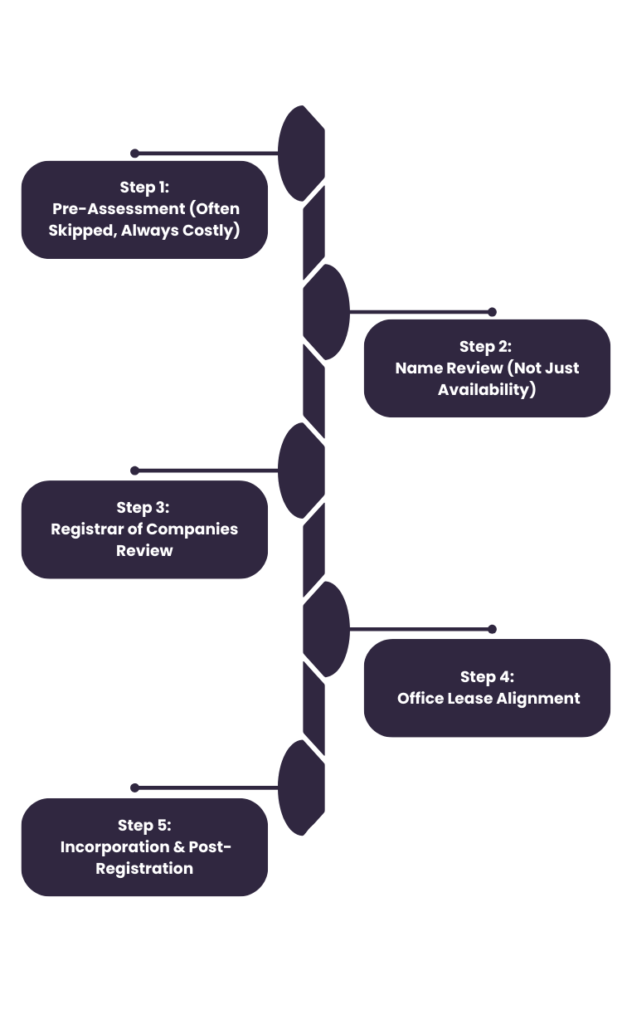
DIFC Setup Process – What Actually Happens
Step 1: Pre-Assessment (Often Skipped, Always Costly)
DIFC internally evaluates:
Business model credibility
Jurisdictional fit
Substance logic
Skipping this step is why timelines fail later.
Step 2: Name Review (Not Just Availability)
Names are reviewed for:
Market positioning
Regulatory sensitivity
Misleading implications
Names implying regulated activity without approval frequently stall.
Step 3: Registrar of Companies Review
This is where most “delays” occur.
The Registrar examines:
Shareholding clarity
UBO structure
Alignment between documents and narrative
Step 4: Office Lease Alignment
Securing an office too early or too late can derail timelines.
DIFC expects:
Office type consistent with license
Substance proportionality
Real occupancy plans
Step 5: Incorporation & Post-Registration
Incorporation is not the end.
It is the start of banking, tax, and compliance scrutiny.
Realistic timelines (not brochure claims):
Well-prepared structures: 6–8 weeks
Complex or cross-border cases: 8–12+ weeks
DIFC Office Requirements – The Most Misunderstood Area
DIFC allows:
Physical offices
Approved flexi or shared arrangements
However, banks apply a stricter standard than DIFC.
Common failure pattern:
“DIFC accepted the office, but the bank rejected the account.”
Banks evaluate:
Actual occupancy
Staffing plausibility
Operational reality
An office that is technically compliant but commercially weak is one of the fastest ways to lose banking credibility.
Banking for DIFC Companies (Hard Truth Section)
DIFC does not guarantee a bank account.
Banks assess:
Founder profile and nationality
Source of wealth and funds
Business activity risk
Jurisdictional exposure
Substance vs structure alignment
Common misconceptions:
“DIFC companies are automatically low risk”
“Premium free zone equals easy banking”
In reality, DIFC entities are often more heavily scrutinised, not less.
Banking success depends on:
Pre-banking structuring
Correct license-office alignment
Clear transaction logic
Weak consultants focus on incorporation.
Strong advisors design the structure backwards from banking.
DIFC Tax, Audit & Compliance Reality (2026-Ready)
Corporate Tax
The “0% DIFC tax” narrative is widely misunderstood.
DIFC entities are subject to UAE Corporate Tax law, with outcomes depending on:
Qualifying income
Economic substance
Related-party arrangements
Misclassification can expose DIFC companies to unexpected tax positions.
Audit Obligations
Most DIFC companies are required to:
Appoint an auditor
File audited financial statements
Banks routinely request audited accounts even where regulators do not immediately enforce them.
ESR, UBO & AML
DIFC applies:
Robust UBO disclosure
AML alignment consistent with international standards
Substance expectations aligned with global scrutiny
Compared to Mainland, DIFC entities are often perceived by banks as:
More transparent
More enforceable
But less tolerant of weak governance
DIFC vs ADGM vs Mainland (Decision Matrix)
| Factor | DIFC | ADGM | Mainland |
|---|---|---|---|
| Legal System | Common law | Common law | Civil law |
| Courts | Independent DIFC Courts | Independent ADGM Courts | Onshore UAE courts |
| Banking Perception | High scrutiny | High scrutiny | Variable |
| Cost Base | High | High | Medium |
| Compliance Burden | High | High | Moderate |
| Ideal Use | Holdings, advisory, finance | Funds, SPVs, fintech | Operating businesses |
Abu Dhabi Global Market and DIFC are peers, not substitutes.
Mainland is often more practical for revenue-driven operations.
Common DIFC Setup Mistakes (From Real Cases)
Choosing DIFC for prestige, not suitability
Selecting the wrong license category
Using minimal offices that banks reject
Over-engineering structures
Attempting banking after incorporation instead of before
Each of these mistakes is avoidable — but only with advisory-led structuring.
How Business & Beyond Handles DIFC Differently
Business & Beyond does not treat DIFC as a product.
The approach is:
Advisory-first, not form-first
Banking logic designed before incorporation
License and office aligned to substance, not cost
Governance and compliance planned from day one
There are no promises of speed or ease.
There is a methodology built around regulatory acceptance and long-term viability.
That difference becomes visible not at incorporation —
but at banking, audit, and regulatory review stages.

If you need high-quality, professional, and friendly business consulting, look no further than Business & Beyond Consulting.
Contact
Bromley – Kent , London UK
Copyright © 2025 – Designed by Business & Beyond – Dubai, UAE