

How to Set Up a Business in the UAE (Dubai) — A Regulator-Grade, Bank-Ready Guide
To set up a business in the UAE, you must select the correct jurisdiction (Dubai Mainland or a Free Zone), secure an activity-accurate trade licence, complete immigration and establishment registrations, open a compliant corporate bank account, and activate post-licensing tax and regulatory filings (VAT, Corporate Tax, ESR, UBO). In Dubai, success depends less on speed and more on structural correctness from day one.
This guide is written as a senior business setup consultant in Dubai would advise a boardroom—not as a marketing brochure. It reflects 2025–2026 UAE compliance reality, banking expectations, and what actually works on the ground.
Why “business setup in Dubai” fails for many founders (and how to avoid it)
Most online pages reduce UAE incorporation to a checklist. In practice, bank rejections, licence misalignment, tax exposure, and visa blocks arise because decisions were made in the wrong order. The UAE is fast—but only when your structure is bank-ready, tax-ready, and regulator-aligned.
What consultants usually say
- “Mainland vs Free Zone—pick one”
- “Get licence in days”
- “Open bank account after”
What works in real UAE setups
- Start with banking & tax logic, then choose jurisdiction
- Map actual revenue flows to licence activity codes
- Align visas, ESR, UBO, VAT, and Corporate Tax before issuance
Step 1: Choose the right jurisdiction (the decision that controls everything)
Dubai Mainland (onshore)
Licensed through Dubai Department of Economy and Tourism (DET), Mainland entities can trade anywhere in the UAE, contract with government, and operate without geographic limits.
Best for
- Consulting, trading, services with UAE clients
- Retail, construction, logistics
- Businesses needing flexibility with visas and office locations
2026 reality
- 100% foreign ownership is permitted for most activities
- Physical office (Ejari) often required for banking credibility
- Enhanced scrutiny on substance and management presence
Free Zone
Regulated by individual authorities (e.g., IFZA, Meydan Free Zone). Ideal for cross-border, holding, and digital businesses.
Best for
- International consulting & trading
- Holding companies and IP structures
- Startups prioritising speed and bundled visas
2026 reality
- Banking due diligence is stricter for “virtual” offices
- ESR substance tests apply where relevant
- Mainland clients may require distributors/branches
Advisor rule: If your revenue touches the UAE market directly, Mainland often wins. If revenues are offshore, a properly structured Free Zone can be optimal.
Step 2: Select the correct business activity (this is non-negotiable)
Your activity code determines:
- Licence approval
- Banking acceptance
- VAT treatment
- Corporate Tax profile
- Audit & ESR obligations
Misclassification is the #1 cause of bank rejection.
Examples
- “Management consultancy” ≠ “Marketing services”
- “General trading” ≠ “Specific commodity trading”
- “IT consultancy” ≠ “Software development”
Execution tip: Map actual invoices you will issue to the licence activity—before applying.
Step 3: Decide the legal form (LLC, branch, sole establishment)
- LLC: Most common; scalable; preferred by banks
- Branch: Ties you to a parent entity (foreign or UAE)
- Sole establishment: Limited use; personal liability considerations
Banking reality: Multi-shareholder LLCs with clear governance are processed faster than nominee-heavy or opaque structures.
Step 4: Name reservation, initial approval, and constitutional documents
At this stage, regulators verify:
- Shareholder background
- Sanctions & AML screening
- Activity permissibility
Documents prepared
- Memorandum of Association (MOA)
- Shareholder resolutions
- UBO declaration (ultimate beneficial owner)
Authority touchpoints
- Ministry of Economy (commercial registers)
- Free Zone registrars (as applicable)
Step 5: Office, Ejari, and substance alignment
Mainland
- Ejari-registered office often required
- Flexi-desk may be acceptable initially but weak for banks
Free Zone
- Flexi-desk / smart office common
- Substance expectations rising for ESR & banking
2026 banking standard: Banks increasingly request proof of real operations—contracts, emails, and management presence.
Step 6: Immigration & visas (founder, partner, employees)
Once licensed:
- Establishment card
- Entry permits
- Emirates ID & medicals
Typical ranges
- 2–5 visas bundled in many Free Zones
- Mainland visas linked to office size and activity
Planning insight: Over-issuing visas early can complicate banking and ESR. Issue what you need.
Step 7: Corporate bank account (the real test of your setup)
Opening a bank account is not automatic.
Banks assess:
- Licence vs actual activity
- Shareholder profile & nationality mix
- Expected transaction flows
- Office & visa substance
- Tax registrations
What works
- Clean, single-purpose structure
- Clear source of funds
- UAE-resident signatory where possible
What fails
- Generic “consultancy” licences with trading behaviour
- Multiple activities with no clarity
- No physical or managerial presence
Step 8: Post-licensing compliance (where most founders slip)
VAT
Register if taxable supplies exceed AED 375,000.
Regulated by Federal Tax Authority.
Corporate Tax (Federal Decree-Law No. 47 of 2022)
- 9% on taxable profits above AED 375,000
- Free Zone benefits apply only if conditions are met
- Improper structuring can disqualify incentives
ESR (Economic Substance Regulations)
Applies to relevant activities (distribution, services, holding, etc.).
UBO
Annual confirmation required. Errors trigger fines.
Advisor note: Compliance is not an “afterthought.” It must be engineered at incorporation.
Costs & timelines (realistic 2026 ranges)
| Item | Mainland (AED) | Free Zone (AED) |
|---|---|---|
| Licence & registration | 15,000 – 30,000 | 12,000 – 25,000 |
| Office / Flexi-desk | 10,000 – 50,000+ | 5,000 – 15,000 |
| Visas (per person) | 3,500 – 6,000 | 3,000 – 5,000 |
| Bank setup support | Case-based | Case-based |
Timeline
- Licence: 3–10 working days (structure-dependent)
- Bank account: 2–8 weeks (varies by profile)
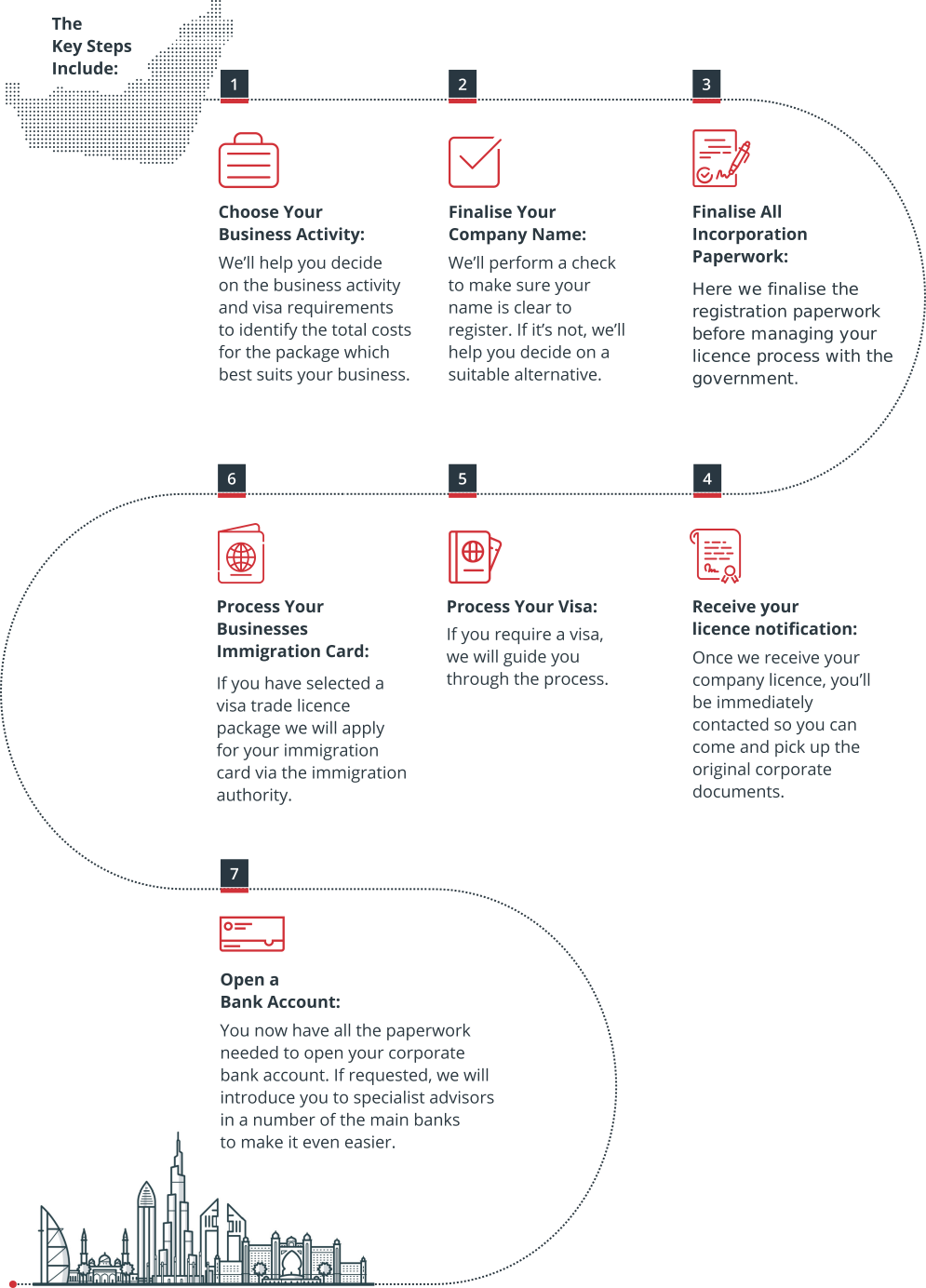

What banks, regulators, and CFOs actually expect in 2026
- One clear revenue story
- No licence/activity mismatch
- Early tax registration planning
- Substance aligned with claims
- Clean governance documents
This is why founders who use a business setup consultant in Dubai with accounting and compliance depth outperform “quick setup” approaches.
Frequently asked follow-ups
- Can I set up a business in Dubai without living there?
Yes—but banking and compliance are significantly easier with UAE residency. - Is Free Zone always tax-free?
No. Corporate Tax rules apply; benefits depend on qualifying criteria. - How fast can I invoice clients?
Immediately after licence issuance—if your bank account is ready.
The Business & Beyond approach (why structures last)
At Business & Beyond, business setup in Dubai is engineered backwards from banking and tax, not forwards from marketing promises. Every structure is:
- Bank-screened
- Tax-mapped
- Regulator-aligned
- Built to scale without re-licensing

Final takeaway
Setting up a business in the UAE is straightforward only when done correctly. The real differentiator is not the licence—it is structural intelligence.

Leave A Comment