

Memorandum of Association (MoA) in the UAE: Meaning, Clauses, Costs, Risks & Compliance Reality
Why the MoA Is the Most Misunderstood UAE Business Document
In the UAE, the Memorandum of Association (MoA) is often treated as a formality—a document to be signed, notarised, and forgotten. This assumption is one of the costliest mistakes founders make.
In reality, the MoA is not just a formation document. It is a legally binding charter that regulators, banks, tax authorities, courts, and investors rely on to interpret:
- Who truly owns the company
- Who controls management decisions
- What the company is legally allowed to do
- How profits, losses, and liabilities are shared
- Whether the company’s structure is compliant with UAE law and tax rules
At Business & Beyond, we see MoAs again when things go wrong:
bank accounts rejected, shareholder disputes escalated, corporate tax positions challenged, or licence renewals blocked.
This 2026 guide explains the real function of a UAE MoA, the clauses that matter, the mistakes consultants don’t disclose, and how to draft one that survives regulatory, banking, and tax scrutiny.
What Is a Memorandum of Association in the UAE?
A Memorandum of Association (MoA) is the foundational legal document of a UAE company. It defines the company’s external legal identity and relationship with the state.
In the UAE, a valid MoA is mandatory for most company types established through:
- Department of Economic Development (mainland companies)
- Relevant free zone authorities such as Dubai Multi Commodities Centre or International Free Zone Authority
Without an approved and notarised MoA, a company cannot:
- Obtain a trade licence
- Open a corporate bank account
- Issue visas
- Sign enforceable commercial contracts
MoA vs Articles of Association (AoA): A Critical Legal Distinction
Many founders confuse the MoA with the Articles of Association (AoA). While related, they serve different legal purposes.
| Aspect | Memorandum of Association (MoA) | Articles of Association (AoA) |
|---|---|---|
| Legal role | External charter of the company | Internal rulebook |
| Focus | Name, activities, capital, shareholders | Management, voting, meetings |
| Regulator reliance | High | Moderate |
| Bank & tax review | Yes | Limited |
| Amendment impact | Licence, ownership, tax | Internal governance |
Regulatory reality (2026):
Authorities and banks prioritise the MoA over the AoA when assessing compliance, ownership substance, and control.
Mainland vs Free Zone MoA: What You Can and Cannot Customise


Mainland Companies (DED-Regulated)
Mainland MoAs follow standardised templates aligned with the UAE Commercial Companies Law and overseen by the relevant DED.
Key characteristics:
- Limited flexibility in wording
- Mandatory Arabic or bilingual format
- Strict rules on ownership, capital, and management powers
- Notarisation before a UAE public notary
Free Zone Companies
Free zones offer greater drafting flexibility, but this does not mean fewer risks.
Key characteristics:
- Pre-approved templates with optional clauses
- Faster approval timelines
- Still reviewed by banks and tax authorities
- Often misunderstood as “simpler” (they are not)
⚠️ Critical insight:
Banks and the Federal Tax Authority assess substance over free zone branding. A weak MoA in a free zone still causes rejections.
Key Clauses in a UAE MoA (And Why They Matter in Practice)
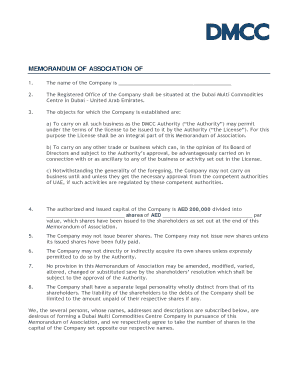

1. Company Name & Legal Form
Determines how the company appears in official registries and contracts. Errors here delay licensing and banking.
2. Business Activities Clause
The most operationally dangerous clause if poorly drafted.
- Companies may only operate within listed activities
- Activity mismatches lead to penalties and licence suspension
- Corporate tax positions must align with stated activities
3. Capital & Ownership Structure
Defines:
- Shareholding percentages
- Capital contributions (cash or in-kind)
- Liability limits
⚠️ Banks use this clause to identify ultimate beneficial owners (UBOs).
4. Profit & Loss Distribution
Often copied blindly—this clause:
- Drives shareholder disputes
- Affects tax and dividend planning
- Must align with economic reality
5. Management & Authority Clause
One of the most litigated areas in UAE courts.
Poor drafting can:
- Give unilateral power to one partner
- Block exits or amendments
- Invalidate internal agreements
6. Amendment Clause
Defines how and when the MoA can be changed.
Hidden risk:
If amendment thresholds are unrealistic, future restructuring becomes impossible.
How Regulators, Banks & Tax Authorities Actually Use Your MoA
This is where most online articles stop—but where real risk begins.
Banks
- Validate ownership & control
- Assess source of funds
- Cross-check activities with transactions
Common outcome:
Bank account rejected due to vague or inconsistent MoA wording.
Tax Authorities (FTA)
- Match activities to corporate tax registration
- Assess substance vs paper structure
- Review profit allocation logic
Regulators
- Verify compliance with licensing conditions
- Enforce activity limitations
- Investigate disputes using MoA wording
Corporate Tax (UAE) & the MoA: The Hidden Compliance Link
Since the introduction of UAE Corporate Tax, the MoA has gained new importance.
The FTA relies on the MoA to:
- Determine taxable activities
- Assess related-party arrangements
- Evaluate profit allocation fairness
⚠️ Mismatch risk:
If your MoA states “consultancy” but revenue reflects trading or agency activity, this raises red flags during audits.
Cost of Drafting & Registering a MoA in the UAE (2026)
| Structure | Typical Cost Range |
|---|---|
| Mainland LLC (MoA + licence) | AED 22,000 – AED 25,000 |
| Free Zone Company | AED 15,000 – AED 30,000 |
| MoA Amendment | AED 2,000 – AED 5,000+ |
Costs vary based on:
- Emirate
- Activity complexity
- Number of shareholders
- Amendment scope
Common MoA Mistakes Consultants Don’t Disclose
| Mistake | Real-World Impact |
|---|---|
| Copy-paste clauses | Bank rejection |
| Overbroad activities | Regulatory scrutiny |
| Weak management clauses | Shareholder disputes |
| No exit planning | Locked ownership |
| Ignoring tax alignment | Audit exposure |
When Professional MoA Drafting Is Not Optional
You should not rely on templates if:
- There are multiple shareholders
- Profits are not shared equally
- One partner manages operations
- External investors are involved
- Corporate tax optimisation matters
- Banking approval is critical
This is where Business & Beyond operates—not as document processors, but as risk architects.
Frequently Asked Questions (FAQs)
Is a MoA mandatory for all UAE companies?
Yes, for most company structures, including LLCs and free zone entities.
Can a MoA be amended later?
Yes, but amendments require authority approval and may impact banking and tax positions.
Does a sole proprietorship need a MoA?
Usually no, but specific activities or emirates may require additional documentation.
Does the MoA affect visas?
Yes. Visa eligibility and quotas often depend on activity and ownership clauses.
Is the MoA reviewed during audits?
Yes—by banks, regulators, and the FTA.
Final Advisory Note from Business & Beyond
A UAE Memorandum of Association is not paperwork.
It is a legal, tax, and operational control document that follows your business for its entire lifecycle.
Most consultants draft MoAs to start companies.
We draft MoAs to protect them.
If you want your company structure to survive banking, tax audits, shareholder exits, and regulatory scrutiny, your MoA must be drafted with professional foresight—not templates.
About Business & Beyond
Business & Beyond is a UAE-based business setup, tax, and compliance advisory firm working with founders, SMEs, and international investors across mainland and free zones. Our work integrates company formation, corporate tax, banking readiness, and compliance risk management—not just licensing.

Leave A Comment