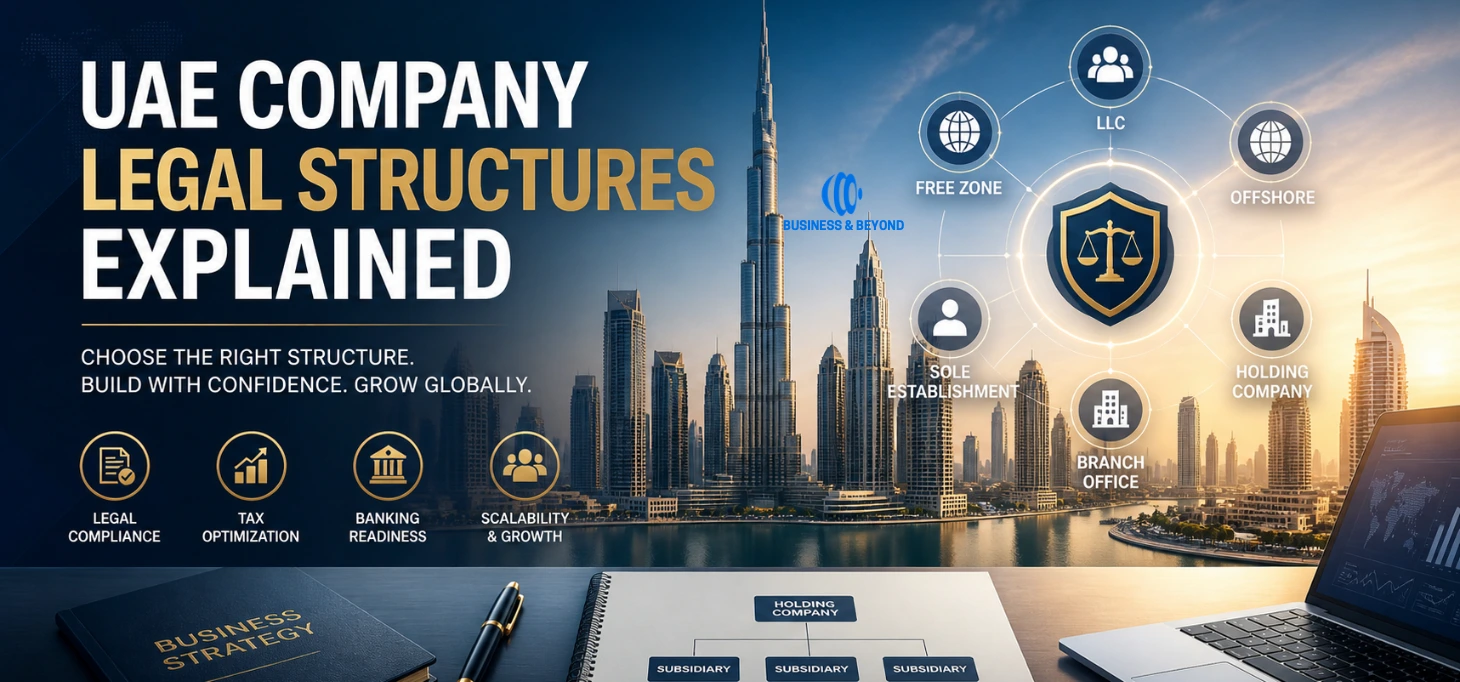
UAE Company Legal Structures Explained (2026)
Choosing the wrong business structure in the UAE costs founders AED 50,000–200,000 in unexpected taxes, restructuring fees, and lost opportunities. The “cheapest” option rarely becomes the “smartest” option.
This guide explains the 7 main structures and shows you which one actually fits YOUR business—not based on cost, but based on your market, growth plans, and banking reality.
Quick question: Are you serving UAE local customers or international clients? Taking investor funding? Need to hire staff fast? These answers determine everything.
The 7 UAE Business Structures (At a Glance)
Mainland Structures
1. Limited Liability Company (LLC)
- 100% foreign ownership allowed
- Best for: Local UAE market businesses
- Tax: 0% up to AED 375K profit, then 9%
- Banking approval: 85–90% ✅
- Setup time: 3–4 weeks
2. Sole Establishment (Professional)
- For solo professionals (lawyers, consultants, doctors)
- 100% single owner
- Lowest cost (AED 4K–6K)
- Banking approval: 60–70% ⚠️
- Can’t easily add partners later
3. Civil Company
- For 2+ professionals
- 100% foreign ownership possible
- Banking approval: 75–80% ✅
- Best credibility for professional services
Free Zone Structures
- 100% foreign ownership
- Tax: 0% (zone-income only)
- Setup: 5–7 days (fastest)
- Cost: AED 3K–5K (cheapest)
- Critical trap: One local UAE sale = lose tax exemption
- Banking approval: 70–80%
5. Free Zone Establishment (FZE)
- Single shareholder version of FZCO
- Same rules, just one owner
- Slightly harder banking approval (65–75%)
Learn more: FZE vs FZCO in Dubai: Choosing the Right Free Zone Entity
Offshore & Other
- No UAE trading allowed
- For holding real estate, IP, investment vehicles
- 0% tax (no business allowed)
- Banking approval: 20–30% ❌ (heavily scrutinized post-FATCA)
- Setup: 7–10 days
7. Branch Office
- Extension of foreign parent company
- Parent company fully liable
- Banking approval: 85–90% ✅ (parent reputation helps)
- Good for multinational expansion
Which Structure Should You Choose? (Decision Framework)
IF your customers are in Dubai/UAE locally:
→ MAINLAND LLC
Why: Direct market access, government contract eligibility, straightforward banking, tax-friendly (AED 375K threshold). Reality: Pay 9% corporate tax on profits above threshold. It’s predictable.
IF you’re 100% export-focused (international clients only):
→ FREE ZONE COMPANY
Why: 0% tax, fastest setup, lowest cost. Watch out: One local sale and your 0% exemption vanishes. Banks need customer contracts.
IF you’re a solo professional:
→ SOLE ESTABLISHMENT
Why: Fastest, cheapest. Limitation: Can’t easily add partners or raise funding later.
IF you’re raising VC funding:
→ MAINLAND LLC (operations) + OFFSHORE HOLDING (investor vehicle)
Why: Investors expect mainland presence. Offshore provides tax efficiency. Cost: AED 15K–25K.
IF you’re testing a foreign market:
→ BRANCH OFFICE
Why: Leverage parent reputation. Parent guarantee helps banking.
The Banking Perspective (Why This Matters Most)
Most entrepreneurs choose structures based on cost or tax. Banks choose based on risk.
| Structure | Bank Approval | Time | Why |
|---|---|---|---|
| Mainland LLC | 85–90% ✅ | 5–10 days | Regulated, audited, transparent |
| Free Zone FZCO | 70–80% ⚠️ | 10–15 days | Need customer contracts; zone concerns |
| Sole Establishment | 60–70% ⚠️ | 7–14 days | Single-owner risk |
| Civil Company | 75–80% ✅ | 5–10 days | Professional credibility |
| Offshore | 20–30% ❌ | 30–60 days | FATCA scrutiny; UBO requirements |
| Branch Office | 85–90% ✅ | 3–7 days | Parent company backing |
The hidden truth: Choosing free zone to save AED 7K often costs AED 20K+ in banking delays. By approval time, you’ve lost 4–6 weeks of business.
Real Case Study: Wrong vs Right Structure
Founder: Tech consultant starting in Dubai. Needs first client in 30 days.
WRONG: Free Zone Company
- Setup: 5 days ✅
- Banking: 3 weeks ⚠️ (bank wanted business plan + contracts)
- Revenue start: Day 28 (client lost)
- Year 2: Started selling to UAE customers. Tax authority: “Your exemption is forfeited. Pay 9% retroactively.”
- Total cost: AED 4K setup + AED 30K lost opportunity + AED 50K+ tax = AED 84K+ damage
RIGHT: Mainland LLC
- Setup: 3 weeks
- Banking: 1 week (streamlined, low-risk)
- Revenue start: Day 22 (on time)
- Year 2: No surprises. Expected tax bill.
- Total cost: AED 10K setup = AED 10K total
Lesson: The AED 6K difference in setup cost saved AED 74K in complications later.
5 Common Mistakes (And How to Avoid Them)
- Choose by cost alone → Choose by total cost (setup + tax + banking time + restructuring)
- Assume free zone = 0% everywhere → 0% applies only to zone-origin income
- Ignore banking approval difficulty → Banking delays cost more than setup fees
- Don’t plan for scale → Choose structure that fits your 3-year plan
- Wrong structure for funding → Investor-ready structures need planning upfront
How Business & Beyond Helps
We act as your business setup consultant in Dubai—not a paperwork processor.
Step 1: Strategic assessment. Where are your customers? Raising funding? 3-year plan?
Step 2: Structure recommendation. Not the cheapest. The smartest.
Step 3: Execution. Setup correctly. Banking introduction. Tax alignment.
Step 4: Ongoing support. Year 2 hiring? Year 3 funding? We optimize as you grow.
Book Your Free 30-Minute Structure Strategy Call
Choose correctly from day one. It costs nothing to ask.